
By Clarice Tchatat Bangoun
NUJ South West England Branch
TOLPUDDLE: There are places where the past does not merely belong to history, it disrupts the present. For a weekend in July, the small Dorset village of Tolpuddle transformed into a vibrant, sprawling pop-up city; hundreds of tents, caravans as far as the eye could see, and a sea of people from every corner of the United Kingdom. Officially, we gathered to commemorate the sacrifice of George Loveless and five companions – agricultural labourers deported in 1834 for daring to swear an oath of workers’ solidarity. The 2026 edition exposed a more contemporary urgency: the desperate need to defend human intellect against the automated takeover of our lives and professions.
The brilliance of organisation
Arriving on-site on Friday evening under a wave of intense heat, one felt the finely tuned machinery of what was once called brotherhood, to which we now add and assert sisterhood. Beyond the poetry of songs and the fire of debates, the sheer logistical precision was striking. Spotless walkways, crystal clear signage, and an army of dedicated volunteers working in the background to ensure nothing left to chance. If this festival exudes peace and confidence, it is because its foundations are rock-solid.

Throughout the crowds, causes intersected and answered one another. Banners standing in solidarity with Sudan, Palestine, Nicaragua, and Western Sahara stood alongside badges and placards reading ‘Welcome Refugees’ and ‘Stand Up to Racism’. Inside the International Tent, delegates from Sudan remind us of the horrors and root causes of a devastating civil war, launching a vibrant appeal for truth and international solidarity. We cross paths with Chris Welsford, founder of Antithesis Research Limited, the co-operative that researches and exposes corporate greenwashing. He sees his work as an heir to the 1834 struggle, reminding us of the invisible thread that that connects us all.
This historical legacy felt profoundly alive in the curious and attentive eyes of the many children present, invited to discover this history and claim this heritage as their own. They represent the most beautiful promise made to the six martyrs: that their fight will never die, but will continue to live in the hearts and minds of future generations who will, in turn, know how to carry and tell their story.
The South West demonstrates the strength of diversity
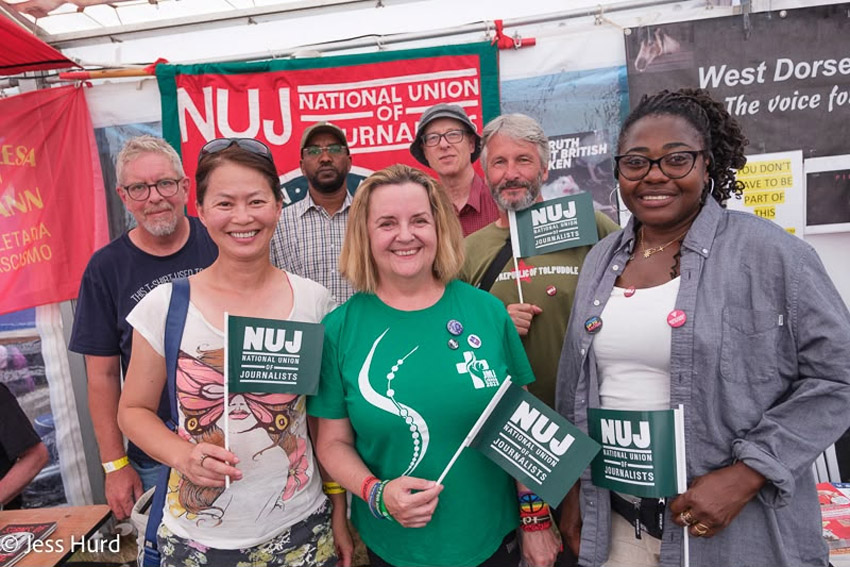
The South West branch acted as a spearhead for the NUJ deploying a dedicated stand, displaying our banner and distributing campaign materials throughout the three day event.

We were a united team of NUJ volunteers out in force from Friday to Sunday, led by Christina Zaba (Vice-Chair and Welfare Officer) and Andy Linington who arrived with campaign materials and leaflets defending the public BBC and outlining NUJ concerns over the impact of uncontrolled use of artificial intelligence.
The team included Simon Chapman (Branch Secretary), Paul Jones and Richard Shrubb. And what made our presence uniquely powerful this year was its global diversity; Yue Parkinson sharing her journalist background from China, Abu-Zain representing Chad, and myself representing Cameroon. We brought unique international perspectives, embodying the global spirit of the union and showing that the fight for media workers’ rights knows no borders. Every member brought their own brick to the building. Between us we maintained a continuous presence throughout the three days.
Artificial Intelligence – the new frontline
The political focal point of our presence unfolded during the panel discussion on Artificial Intelligence – From Tolpuddle to tech-puddles – what would the Martyrs think of AI?

Simon Chapman, a member of the NUJ National Executive Council and its new Copyright and AI Committee, exposed the harsh reality of journalism in 2026, describing how a fellow journalist found that their new job involves collecting material and injecting it into an AI machine to construct the “story” which the journalist then checks. This account of a journalist, reduced to becoming an assistant for a machine, sent a chill through the room. AI writes; the human reads, checks and validates the piece. The result? Newcomers no longer learn how to write, craft and balance a story or how to write a headline (AI now suggests possible headlines for many media including the Guardian and the BBC). Algorithmic tools have the capacity to kill the craft, while generating blunders of its own. One AI headline proposed when Keir Starmer resigned stated that he had died!
The NUJ’s position, reaffirmed forcefully, is not a rejection of technology: yes to the tool, but only under human control, with explicit consent and fair compensation for freelancers whose life’s work is currently pillaged to feed Big Tech’s servers.

Chapman’s call for greater creative rights, echoed by representatives from the Musicians Union (Naomi Pohl), Equity (Linda Rooke), and Unison (Isabella and Kate Jones), contributes to what MP Neil Duncan Jordan called “AI for the people and planet”. Beyond copyright theft lies a dangerous centralisation of power and an ecological disaster driven by data centres. Without human creation, algorithmic systems will simply loop, copying themselves while amplifying bias and error.
”We will be free”
Sunday brought the festival its traditional, moving climax during the grand procession a moment of rare and profound emotional intensity. Following a morning dominated by a scorching sun, the weather grew gentler just as the march began. The air turned cool and temperate, as if the six martyrs themselves were offering their blessing, honoured to see their memory kept so fiercely alive. Along the entire route, the emotion was tangible. Villagers lined the streets and leaned from their windows to connect with marchers chanting for justice. Under this peaceful sky and sustained by waves of applause, the sea of people moved from the heart of the village to the legendary Martyrs’ Tree and the martyrs’ graves. There, beneath the branches, the famous words engraved on the commemorative plaque resonated with historic force: ”We will be free, we will be free, we will be free!” Closing speeches from the main stage hammered home the same truth: if the message of Tolpuddle echoes so loudly today, it is because the fights for social justice and equality remain burning issues. Unity is strength.
As an international journalist and a woman welcomed into this team with absolute respect and dignity, this weekend at Tolpuddle was far more than a volunteer media assignment. It was proof in action. When we march together, doubt changes sides. The pioneers of 1834 paid the price of exile to break their chains; in 2026, we continue the work so that no one, ever, has to walk alone.
Clarice Tchatat Bangoun July 2026

With grateful thanks to Jess Hurd for her photos. Image licensing and archive Jess@jesshurd.com
